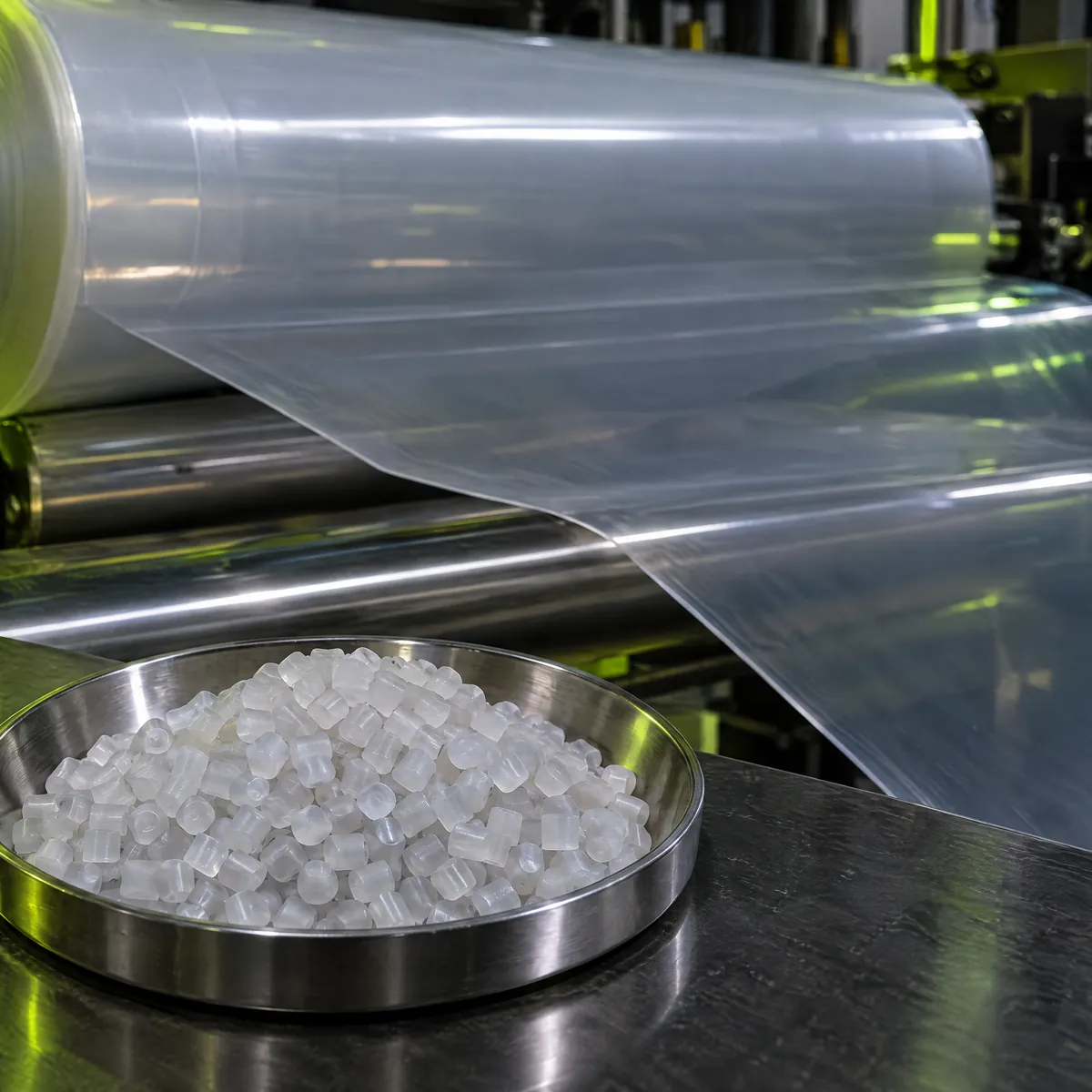
We manufacture high-performance antiblock systems, which are among the most fundamental components determining production efficiency and product quality in the plastic film and packaging industry. Our advanced engineering grade synthetic and natural silica-based solutions, developed to prevent the sticking of polyethylene and polypropylene film layers, create a microscopic level of roughness on the film surface. This technological structure optimizes the coefficient of friction, allowing for maximum speed operation in winding and packaging lines. For a general definition of masterbatch, its structure and how it is used, see our What is Masterbatch? page.
Our antiblock series, prepared with precise formulations in our production facilities, exhibit perfect dispersion within the polymer matrix, completely eliminating the risk of agglomeration and providing a glass-like optical clarity by keeping haze values at a minimum.
You can explore all our product groups on the Erk-Han Masterbatch home page.
Recommended Dosage Rates and Technical Summary
Recommended Dosage
General film applications: 1.0% – 3.0%
Thin transparent films, with synthetic silica: 1.0% – 2.0%
Active Structure
Synthetic and natural silica-based antiblock; creates controlled micro-peaks of 2–6 μm on the film surface
Polymers
LDPE, LLDPE, HDPE, PP and CPP film resins
Processes
Blown film, cast film, multilayer (co-ex) film and lamination films
Test and Target
Blocking force (ASTM D3354) is reduced while optical haze is kept to a minimum
Regulatory
EU 10/2011 / FDA declaration of compliance for food-contact series; REACH, RoHS and SVHC compliance
When very smooth plastic film layers are wound into a roll, the contact area between them grows; intermolecular van der Waals attraction forces and the vacuum effect between layers cause the films to lock onto each other (blocking).
Erk-Han Antiblock Masterbatch creates controlled micro-peaks (asperities) of 2–6 μm on the film surface, reducing the real contact area and lowering the blocking force (ASTM D3354). In synthetic silica-based series, the refractive index (n ≈ 1.46) is chosen close to that of polyolefins (n ≈ 1.50), so optical haze is kept to a minimum.
Field Example
In 25 μm transparent LDPE/LLDPE bag and lamination films, using 1.5% synthetic silica-based antiblock reduces the blocking force from around 80 g to below 15 g; bag mouths open in a single move on the packaging line without catching.
Erk-Han Antiblock Masterbatch Technology Series
Synthetic Silica-Based Transparent SeriesWith synthetic silica whose refractive index is close to that of polyolefins, it keeps haze at the lowest level in thin transparent packaging and lamination films.
Natural Silica-Based SeriesControls blocking in colored, opaque and heavy-duty films where optical clarity is not the priority.
Combined Antiblock and Slip SeriesAntiblock and slip additives are combined in a single granule; film openability and coefficient of friction are adjusted together.
Key Advantages for Your Production Plant
Easy Winding and UnwindingReel layers are prevented from sticking to each other; film breaks are reduced on unwinding, slitting and cutting lines.
Speed on the Packaging LineBag and pouch mouths open in a single move; feeding efficiency increases on high-speed filling machines.
A Choice That Preserves TransparencyWith the right choice of silica, haze stays low in thin transparent films and the product's shelf appearance is preserved.
Printing and Corona CompatibilityWorks in harmony with corona treatment and printing ink adhesion.
The Same Performance in Every LotSilica loading and dispersion are checked in every batch; film behavior stays constant from lot to lot.
Main Application Areas and Target Sectors
PackagingFood, textile and courier bags, stretch films and heavy-duty FFS sacks
AgricultureGreenhouse, mulch and industrial agricultural films
TextileTransparent protective and packaging bags for textile products
Supported Polymers and Combined Compatibility
The carrier resin is selected according to the melt flow (MFI) of your film resin, so that the antiblock particles disperse homogeneously in the melt and a uniform micro-roughness forms on the film surface.
Polyethylene FilmsLDPE, LLDPE and HDPE
Polypropylene FilmsCPP and other PP film applications
Combined GranuleAntiblock can be combined in a single granule with color, slip, antistatic, anti-fog and UV and light stabilizer additives; this lets you run with a single doser and eliminates mixing errors.
Erk-Han Laboratory Assurance
Ash FurnaceActive silica loading is verified by ash analysis.
FPV Filter Pressure TestDispersion quality and screen clogging tendency are checked by the filter pressure value.
MFI / MVRThe carrier's flow value is measured for compatibility with the film resin.
TGAThermal stability and active content are checked by thermogravimetric analysis.
SpectrophotometryColor deviation (ΔE) in colored and transparent films is measured and monitored.
PE and PP packaging films (LDPE, LLDPE, HDPE, BOPP, CPP)
Food, textile and courier bags
Greenhouse, mulch and industrial agricultural films
Lamination and barrier films
Stretch film and heavy-duty sacks (FFS)
Affected Properties / Effects on the Final Product
Separability of film layers: Completely prevents film layers from sticking to each other (blocking) after winding.
Surface roughness (micro-topography): Creates microscopic peaks invisible to the eye on the film surface, breaking the vacuum effect.
Coefficient of friction (COF): Balances static and dynamic frictional resistance.
Optical clarity (haze & transparency): With the right choice of mineral/synthetic silica, it provides openability in transparent films without causing haze.
Easy opening (openability): Ensures bags open easily during filling and use.
Effect on the Process and Production Line
Prevents film breaks on winding and unwinding lines.
Increases feeding efficiency on high-speed packaging machines.
Fully compatible with corona treatment and printing ink adhesion.
A 50-question technical guide compiled from the field experience of the Erk-Han engineering team.
What is antiblock masterbatch?
Antiblock masterbatch is an additive concentrate used to prevent plastic film layers from sticking to each other (blocking) during production, winding and storage. The mineral particles it contains create microscopic roughness on the film surface, reducing the contact area between layers and allowing the film to open easily.
Why does blocking occur?
Blocking results from the combination of molecular proximity between two film surfaces, low surface roughness, pressure (winding tension, stacking load) and heat. The flatter and cleaner the surfaces in contact, the stronger the attractive forces; an antiblock additive physically reduces this contact area and prevents sticking.
Which minerals are antiblock additives made from?
The most common antiblock minerals are synthetic amorphous silica, natural diatomite (kieselguhr), talc, calcium carbonate and nepheline syenite. Erk-Han uses synthetic or natural silica-based carriers with the particle size and structure best suited to the application.
What is the difference between synthetic and natural silica?
Synthetic amorphous silica offers a controlled particle size distribution, high purity and excellent optical clarity; it is preferred in demanding packaging films. Natural diatomite is more economical and is used at higher dosages, but it can reduce optical clarity somewhat.
Are antiblock and slip masterbatch the same thing?
No. Antiblock prevents sticking by creating physical roughness on the surface, while a slip additive makes the surface slippery and lowers the coefficient of friction (COF). The two are used together in most films: antiblock opens the film, and slip helps it glide through the machine.
Why are antiblock and slip used together?
With antiblock alone, the film opens but surface friction may remain high; with slip alone, friction drops but blocking may continue. A balanced combination of the two delivers both low COF and easy opening, ensuring trouble-free running on packaging lines.
At what dosage is antiblock masterbatch used?
The typical dosage is in the range of 1–3%, depending on the active silica content of the carrier and the film thickness. In thin films and applications requiring high clarity, the dosage is optimized; the exact ratio is determined through sample trials.
How does increasing the dosage affect clarity?
As the antiblock dosage increases, particle density on the surface rises, light scattering (haze) increases and clarity drops. The aim is therefore to achieve sufficient antiblock performance at the lowest dosage; particle size selection plays a critical role in this balance.
Why is particle size important?
Particle size determines the height of the asperities protruding from the film surface. Particles that are too small do not create enough roughness and the antiblock effect stays weak; particles that are too large lead to increased haze, surface scratches and filter clogging. Choosing a size that suits the film thickness is essential.
Does antiblock impair the optical clarity of the film?
When the right mineral, the right particle size and the optimum dosage are selected, clarity loss is kept to a minimum. Erk-Han formulations use synthetic silicas with a refractive index close to that of the polymer, targeting near glass-clear optical values.
What is the haze value and how does it relate to antiblock?
Haze is an optical value, expressed as a percentage, that measures the proportion of light scattered as it passes through the film. Because antiblock particles create surface roughness, they raise haze somewhat; with high-quality synthetic silica this increase is kept to a minimum.
What is the coefficient of friction (COF)?
COF (coefficient of friction) expresses the resistance of two surfaces to sliding against each other. Antiblock lowers the static COF (sticking), while the dynamic COF is usually controlled with a slip additive. On packaging lines, the target COF value is set according to the application.
In which polymers is antiblock masterbatch used?
It is used mostly in polyethylene (LDPE, LLDPE, HDPE) and polypropylene (PP) films. It is also applied in PET, EVA and multilayer barrier films. The carrier resin is selected to be compatible with the main polymer of the film.
Why must the carrier resin be compatible with the main polymer?
If the carrier resin is incompatible with the main polymer, the masterbatch does not disperse well, and phase separation, gel formation and optical defects can occur. A compatible carrier allows the silica particles to disperse homogeneously in the film matrix and ensures consistent surface roughness.
How does antiblock behave in blown film production?
In the blown film process, antiblock particles migrate to the surface as the bubble cools and create roughness. Bubble stability and cooling rate affect how the particles are distributed on the surface; the formulation should be optimized for this process.
Is antiblock used differently in cast film production?
In cast film, cooling is very fast and takes place from a single surface, so the surface morphology differs from blown film. In this process, particle size and dosage are adjusted to provide sufficient roughness under rapid cooling.
In which layer of a multilayer (co-ex) film is antiblock placed?
Antiblock is usually added only to the outer (contact) layers; adding it to the inner layers is unnecessary and lowers the optical values. This approach reduces cost and preserves clarity while providing the antiblock effect only on the surface that needs it.
Does antiblock affect the heat sealability of the film?
A high antiblock dosage can increase particle density on the seal surface and reduce heat seal strength somewhat. For this reason, the dosage in the seal layer is carefully optimized, or the seal area is formulated separately.
Does antiblock masterbatch affect print quality?
Excessive surface roughness can adversely affect ink transfer and print sharpness. With the right dosage and particle size, antiblock both prevents sticking and provides a surface suitable for flexo and rotogravure printing.
Can antiblock be used in food packaging?
Yes. Erk-Han antiblock formulations can be produced using minerals and carriers suitable for food contact. Declarations of compliance with the relevant food contact regulations (e.g. EU 10/2011, FDA) are provided on request.
Is antiblock masterbatch REACH and RoHS compliant?
Erk-Han antiblock products are manufactured with raw materials that meet REACH and RoHS requirements. SVHC-free formulations and the related declarations are provided to the customer as part of the product safety documentation.
What happens if the antiblock dosage is too low?
If the dosage is insufficient, not enough roughness forms on the surface, film rolls or bags stick together and opening becomes difficult. This leads to machine stoppages, tears and higher scrap rates.
What happens if the antiblock dosage is too high?
Overdosing can cause increased haze, loss of clarity, a powdery surface appearance, weaker heat sealing and filter/screen problems in extrusion. It also raises costs unnecessarily.
How is antiblock performance tested?
Blocking resistance is tested with standard methods (e.g. ASTM D3354) by holding two film surfaces together at a set pressure and temperature and measuring the force needed to separate them. COF (ASTM D1894) and haze (ASTM D1003) measurements are also evaluated.
What does the ASTM D3354 test measure?
ASTM D3354 measures the blocking force (usually in grams) needed to separate two film layers after they have been held under set conditions. Low values indicate good antiblock performance. This test is the basic reference in formulation optimization.
What is antiblock migration?
Some antiblock systems, especially in combination with organic slip additives, migrate to the surface over time and change roughness and COF values. Inorganic antiblocks such as synthetic silica do not migrate, and therefore provide more stable and consistent performance.
Does the antiblock effect decrease over time?
Because inorganic silica-based antiblocks remain embedded in the film matrix, their effect is stable and does not decrease significantly over time. In contrast, systems relying only on migrating organic additives may show changes in performance with ageing.
Does humidity affect antiblock performance?
Some natural mineral antiblocks are hygroscopic and can absorb moisture and agglomerate, which can lead to dispersion problems in extrusion. Erk-Han reduces this risk with proper drying and coated carriers, ensuring stable performance.
How should antiblock masterbatch be stored?
The product should be kept closed in its original packaging in a cool, dry place away from direct sunlight. Protection from moisture is important for dispersion and flowability; the recommended shelf life and conditions are stated in the technical data sheet.
Can antiblock masterbatch be used in recycled polymers?
Yes. Antiblock can also be used in recycled (PCR/PIR) polyethylene and polypropylene films; however, because of the variability of recycled feedstock, dosage and particle selection are usually re-optimized.
Does antiblock reduce the mechanical strength of the film?
At suitable dosages, mechanical properties (tensile strength, elongation, puncture resistance) are not significantly affected. However, very high mineral loading can adversely affect the strength and transparency of the film.
Is antiblock used in agricultural films (greenhouse covers)?
Yes. Antiblock is used in greenhouse and mulch films so that the rolls open easily. In these applications, balanced formulations that preserve durability are usually preferred, together with UV stabilizers and other additives.
How is antiblock used in stretch film?
Because some tackiness (cling) is desired in stretch films, antiblock is dosed carefully; the aim is to prevent unwanted blocking of the rolls while keeping the grip needed for palletizing. This delicate balance requires a special formulation.
Can antiblock masterbatch be used together with colored films?
Yes. Antiblock can be used together with color masterbatch in the same film. Dosages are balanced by taking the total additive load and dispersion into account; if needed, a combined formulation can be produced in a single product.
Can antiblock and UV stabilizer be combined in the same formulation?
Yes. Especially in outdoor and agricultural films, antiblock can be produced as a combined masterbatch with UV and light stabilizers. This reduces dosing errors and simplifies the process.
Why is the dispersion of antiblock masterbatch critical?
Poor dispersion creates silica agglomerates, leading to local haze increases, gel/fish-eye defects and inconsistent surface roughness. Erk-Han produces masterbatch in which the particles are homogeneously dispersed through high-shear compounding.
Can fish-eye defects be caused by antiblock?
Yes. Poorly dispersed or agglomerated antiblock particles can cause defects that appear as fish eyes in the film. Good dispersion, suitable particle size and correct melt conditions minimize this risk.
Does antiblock masterbatch clog the extruder filter?
Well-dispersed particles of suitable size pass through normal filter screens without problems. However, low-quality products with agglomerated or very coarse particles can increase screen pressure and clog the filter; a high-quality masterbatch prevents this problem.
Why is film thickness considered when selecting antiblock?
Particle size should be selected in proportion to film thickness. In very thin films, coarse particles protrude excessively from the surface and cause puncture and haze problems; in thick films, very small particles may not provide enough roughness.
Does antiblock alone make the film slippery?
No. Antiblock mainly prevents sticking (blocking); a slip additive is usually needed for slipperiness on the machine and low dynamic friction. The two complement each other and are used together in most applications.
Which antiblock is preferred in applications requiring high transparency?
For high transparency, synthetic amorphous silica with a refractive index close to that of the polymer and a narrow particle size distribution is preferred. This provides effective antiblock performance with minimum haze.
How is the letdown ratio of antiblock masterbatch determined?
The letdown ratio is calculated from the active silica percentage in the masterbatch and the target active concentration in the film. The optimum ratio is confirmed through sample trials and blocking/haze/COF measurements.
How does using antiblock affect production speed?
Effective antiblock lets rolls and bags open easily, enabling uninterrupted operation at higher speeds on winding and packaging lines. This reduces production losses and downtime, increasing efficiency.
Can antiblock masterbatch be used together with an antistatic additive?
Yes. In applications where dust pick-up and static cling are a problem, antiblock and an antistatic additive can be used together. The formulation is balanced so that the two additives do not adversely affect each other.
Does antiblock transfer odor or taste to food?
Inorganic silica-based antiblocks are inert, so they do not transfer odor or taste. In food contact applications, compliance of all selected components with the relevant migration limits and sensory requirements is verified.
What information should I provide when requesting a sample?
For the most accurate recommendation, simply share the film type (blown/cast), main polymer, film thickness, target clarity/haze value, slip requirement, food contact requirement and the problems you are currently experiencing (sticking, difficulty opening, etc.).
Does Erk-Han make antiblock formulations specific to my application?
Yes. In addition to standard products, Erk-Han develops custom antiblock formulations according to your film type, polymer and performance targets. Sample production and testing support are provided in our R&D laboratory.
Does every lot of antiblock masterbatch deliver the same performance?
Through quality processes that run from incoming raw material inspection to the final product, Erk-Han ensures consistent particle size, active content and dispersion in every lot. This means repeatable antiblock performance in your film from lot to lot.
Can antiblock masterbatch solve bag opening (denesting) problems?
Yes. On automatic filling lines, it is critical that surfaces do not stick to each other so that bags can be separated and opened one by one (denesting). Correctly dosed antiblock lets bag mouths open easily, increasing filling line efficiency and reducing jam-related stoppages.
Can I get technical support for the antiblock product?
Yes. Our technical team provides support on product selection, dosage optimization, process settings and troubleshooting of possible defects. You can reach us through our contact channels for sample requests and consultancy.
Let's find the right solution for your project
Contact our team for sample requests, color matching or technical consultancy.