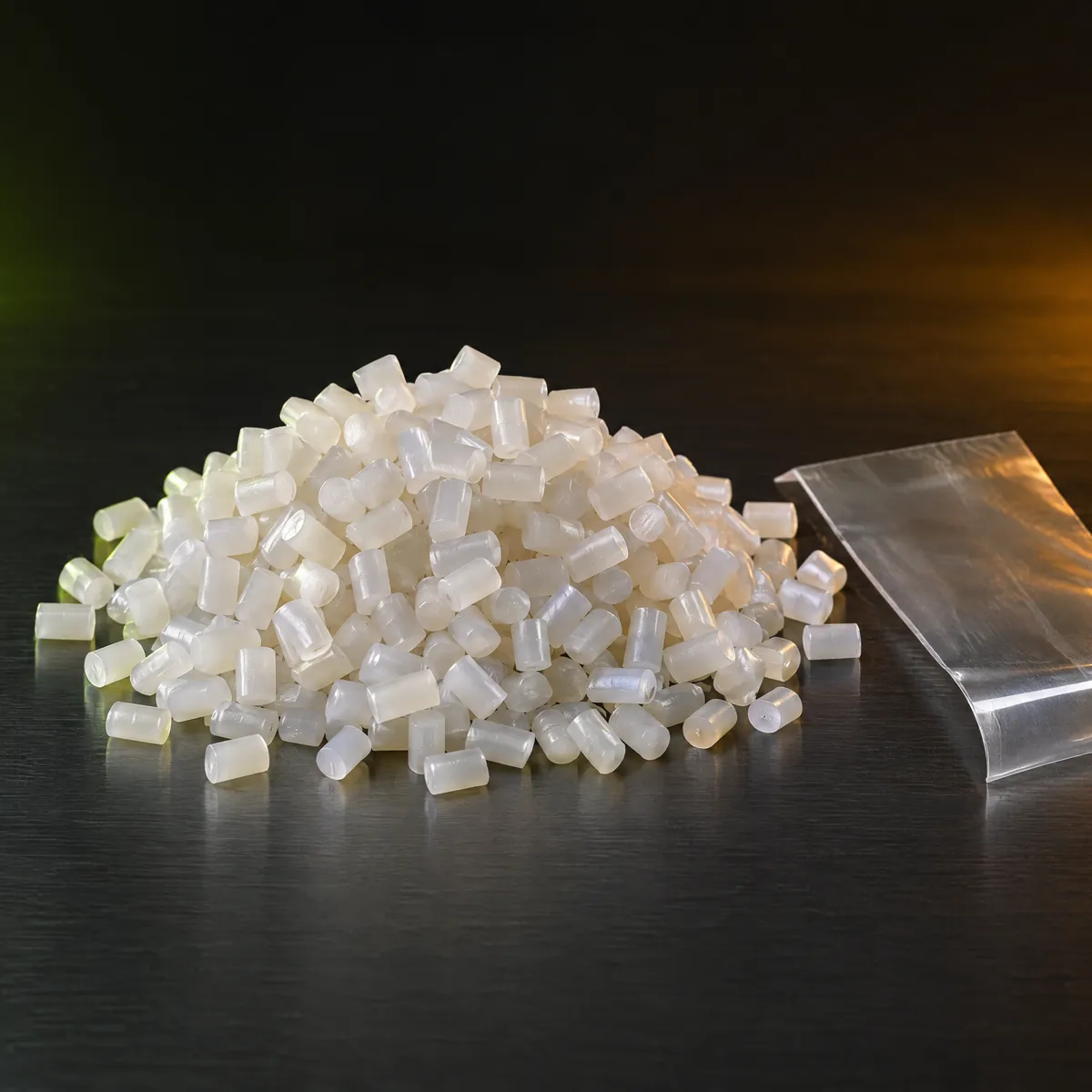
The high heat, mechanical shear forces, and environmental factors that polymers are exposed to during their production and service life lead to the formation of free radicals and thermo-oxidative degradation in polymer chains. Our high-performance antioxidant masterbatch series, developed in Erk-Han R&D laboratories, chemically stops this degradation process and preserves the molecular structure of the polymer. Our formulations, specially prepared with synergistic combinations of primary (phenolic) and secondary (phosphite-based) antioxidants, stabilize the melt flow index during processing while absolutely preventing yellowing, cracking, and loss of mechanical strength (tensile and impact resistance) that may occur over time in the final product.
Designed especially for automotive under-hood parts, infrastructure pipe systems, cable insulations, agricultural films, and long-life packaging applications, these advanced engineering additives ensure that your products maintain their first-day performance and aesthetic appearance for years, even under the harshest climatic and operating conditions.
You can explore all our product groups on the Erk-Han Masterbatch home page.
Recommended Dosage Rates and Technical Summary
Recommended Dosage
General: 0.5% – 2.0%
Recycling and high-heat lines: 1.0% – 2.5%
Active Structure
Synergy of primary (sterically hindered phenol) and secondary (phosphite/phosphonite) antioxidants
Polymers
PP, LDPE, LLDPE, HDPE, plus recycled PCR/PIR and regrind raw materials
Processes
Pipe, raffia, film and cable extrusion; injection, blow and rotational molding; recycling pelletizing lines
Test and Target
Increase in Oxidation Induction Time (OIT, ISO 11357-6); stability of MFI and yellowness index (YI)
Regulatory
EU 10/2011 / FDA declaration of compliance for food-contact series; REACH, RoHS and SVHC compliance
Under high extrusion/injection temperatures and shear forces, plastics generate free radicals (R•, ROO•) and undergo thermo-oxidative degradation; in PP this leads to chain scission (MFI increase and embrittlement), and in PE to crosslinking (gels and black specks).
Erk-Han Antioxidant Masterbatch multiplies the Oxidation Induction Time (OIT, ISO 11357-6) through the synergy of a primary component (sterically hindered phenol) that captures free radicals and a secondary component (phosphite/phosphonite) that decomposes hydroperoxides (ROOH) into harmless alcohols.
Field Example
On PP raffia, pipe and multiple-recycling (regrind/PCR) lines running above 250 °C, a dosage of 0.5% – 1.0% stops the MFI jump and the deterioration of the yellowness index (YI) even in the 3rd and 4th regrind cycles.
Recommended Dosage
In standard injection and blow molding applications: 0.5% – 2.0%
In films and thin-walled packaging applications: 1.5% - 2.5%
In long-life parts exposed to high heat (automotive, pipes, cables): 1.0% – 2.5%
In productions containing recycled polymers (PCR/PIR): It is recommended to increase up to 2.5%.
Erk-Han Antioxidant Masterbatch Technology Series
Process Stabilization SeriesLimits MFI change, gelling and black speck formation during extrusion and injection molding; based mainly on the secondary (phosphite/phosphonite) component.
Long-Term Heat Aging SeriesSlows thermo-oxidative degradation throughout the service life of pipes, cables and automotive under-hood parts; based mainly on the primary phenolic component.
Recycling SeriesA synergistic formulation that stops the MFI jump and yellowing during multiple processing cycles of regrind and PCR raw materials.
Combined Stabilization SeriesAntioxidant is combined with UV and light stabilizer in a single granule to provide both processing and outdoor protection.
Key Advantages for Your Production Plant
Stable MFI and ProcessMelt flow stays constant throughout the process; line settings do not need frequent adjustment.
Stopping Gels, Black Specks and Burn MarksGelling, carbonization and burnt material formation inside the extruder are prevented.
Higher Yield from Recycled Raw MaterialMechanical values are preserved while regrind and flash material is processed more than once.
Color Stability Against YellowingHeat-related yellowing (YI) and burn marks are prevented.
Long Service LifeEmbrittlement, cracking and loss of elongation at break that develop over time in pipes and technical parts are slowed down.
Main Application Areas and Target Sectors
Pipe and ProfilePE and PP drinking water, natural gas, corrugated and drip irrigation pipes
Recycling and CompoundingRegrind, PCR/PIR pellet and compound production
Supported Polymers and Combined Compatibility
The carrier resin is selected according to the melt flow (MFI) of your base polymer, so that the stabilizers disperse homogeneously in the melt and protection is equal at every point of the part.
PolyolefinsPP homopolymer and copolymer, LDPE, LLDPE and HDPE
Recycled Raw MaterialsPCR/PIR and PP/PE regrind
Other PolymersCustom series are prepared for other polymers after carrier compatibility is verified in our laboratory.
Combined GranuleAntioxidant can be combined in a single granule with color, UV and light stabilizer, processing aid and desiccant additives; this lets you run with a single doser and eliminates mixing errors.
Erk-Han Laboratory Assurance
MFI / MVRStabilization effectiveness is verified by measuring the change in flow after repeated processing.
TGAThermal degradation behavior is checked by thermogravimetric analysis.
SpectrophotometryYellowness index (YI) and color change are measured.
Izod / Charpy Impact TestWhether impact strength is preserved after processing is checked.
FPV Filter Pressure TestDispersion quality is checked by the filter pressure value.
PE and PP drinking water, natural gas, corrugated and drip irrigation pipes
Recycled pellet and compound production
Cable insulation and sheathing materials
Automotive under-the-hood plastic parts (exposed to high temperatures)
Thick-walled injection molded parts, rotomolded products and geomembranes
Affected Properties / Effects on the Final Product
Molecular weight and chain integrity: Prevents polymer chains from breaking under the effect of heat and oxygen (thermal oxidation).
Mechanical strength and impact resistance: Prevents the product from becoming brittle and cracking over time and its elongation at break from decreasing.
Melt flow index (MFI) stability: Stops the MFI value from changing uncontrollably during processing.
Yellowing and discoloration: Prevents heat-related yellowing and burn marks.
Long-term aging resistance (OIT): Provides a service life of up to 50 years and Oxidation Induction Time (OIT) standard compliance in pipes and technical parts.
Effect on the Process and Production Line
Stops gel formation, black specks (carbonization) and burnt material inside the extruder.
Allows recycled (regrind/flake) raw material to be processed several times without loss.
A 50-question technical guide compiled from the field experience of the Erk-Han engineering team.
What is antioxidant masterbatch?
Antioxidant masterbatch is an additive concentrate containing a high concentration of antioxidant active substances in a carrier resin, designed to prevent the oxidative degradation that polymers undergo during processing and throughout their service life. At Erk-Han, we formulate these masterbatches to chemically stop free-radical chain reactions. In this way, we provide reliable protection against thermo-oxidative degradation in the final product.
Why do polymers oxidize?
Polymers oxidize because factors such as high processing temperature, mechanical shear forces, UV light and oxygen create free radicals in their molecular chains. These radicals react with oxygen and start a degradation cycle that leads to chain scission and crosslinking. Our antioxidant formulations break this cycle at its source and extend material life.
What is thermo-oxidative degradation?
Thermo-oxidative degradation is a chemical aging process in which heat and oxygen act together to break down polymer chains. This process leads to problems such as loss of mechanical strength, yellowing, brittleness and surface cracking. Our antioxidant masterbatches are developed to slow down thermo-oxidative degradation both during processing and in long-term use.
What is a free radical and why is it harmful?
A free radical is a molecular fragment with an unpaired electron, which makes it extremely reactive. In polymers, these radicals, formed by heat and shear, abstract hydrogen from neighboring chains and trigger a chain degradation reaction. Our antioxidants capture these radicals, break the reaction chain and stop the degradation from spreading.
How does antioxidant masterbatch work?
Antioxidant masterbatch works on the principle that its active substances react with free radicals and convert them into stable, harmless compounds. Primary antioxidants capture radicals, while secondary antioxidants decompose the hydroperoxides that form. In Erk-Han formulations, we combine these two mechanisms synergistically.
What is a primary antioxidant?
Primary antioxidants are radical scavengers, usually with a hindered phenol structure. These substances donate a hydrogen atom to the peroxy radicals formed during oxidation and render them inactive. In our formulations, we use primary antioxidants as the main protective component that directly stops the chain scission reaction.
What is a secondary antioxidant?
Secondary antioxidants are mostly phosphite- or phosphonite-based compounds; they decompose the hydroperoxides formed during oxidation by converting them into stable alcohols. In this way, they prevent the generation of new radicals and lighten the load on the primary antioxidant. At Erk-Han, we prefer these secondary antioxidants especially for processing stabilization.
What is a hindered phenol?
A hindered phenol is a class of antioxidant in which the hydroxyl group of the phenol ring is surrounded by bulky molecular groups. This structure preserves the ability to donate hydrogen while increasing the stability of the molecule and raising its radical-scavenging efficiency. In products requiring long-term heat stabilization, we give these phenolic antioxidants a prominent place in our formulations.
What is the role of phosphite-based antioxidants?
Phosphite-based antioxidants act as secondary antioxidants, decomposing hydroperoxides and preserving the color of the polymer during processing. They improve melt stability, especially under high temperature and shear conditions such as extrusion. In our formulations, we use phosphites together with phenolic antioxidants to provide comprehensive protection.
What is the difference between primary and secondary antioxidants?
Primary antioxidants directly capture free radicals, while secondary antioxidants decompose the hydroperoxides that are the source of radical generation. In other words, one stops the reaction chain and the other prevents new chains from starting. At Erk-Han, we use both types together to create a protection system in which each complements the other.
What does antioxidant synergy mean?
Antioxidant synergy is when the total protection from primary and secondary antioxidants used together is higher than the simple sum of their individual effects. While the phenolic antioxidant captures radicals, the phosphite helps regenerate it and decompose hydroperoxides. In Erk-Han formulations, we optimize these synergistic ratios for each application to achieve maximum efficiency.
Why is a combination used instead of a single antioxidant?
A single type of antioxidant cannot provide full protection because it controls only one stage of the degradation mechanism. A combination of primary and secondary antioxidants covers both radical scavenging and hydroperoxide decomposition, providing broader protection. For this reason, we build our formulations on synergistic combinations.
What is the difference between HALS and antioxidants?
HALS (hindered amine light stabilizers) mainly protect against photo-oxidative degradation caused by UV light, while antioxidants target thermo-oxidative degradation caused by heat and oxygen. The two classes of additives work by different mechanisms and usually complement each other. At Erk-Han, we can formulate these additives separately or together depending on the application.
Are antioxidants and UV stabilizers the same thing?
No, they are not the same. UV stabilizers prevent degradation caused by the ultraviolet radiation in sunlight, while antioxidants prevent degradation caused by heat and oxygen. In outdoor applications, we use these two additive groups together to offer comprehensive protection against both heat and UV.
What is a processing stabilizer?
A processing stabilizer is an antioxidant system that prevents the polymer from degrading during high-temperature production stages such as extrusion or injection molding. This task is usually taken on by phosphite-based secondary antioxidants, because they are effective under short-term exposure to high temperatures. In our formulations, we optimize these components to ensure processing stability.
What is a long-term heat stabilizer?
A long-term heat stabilizer is an antioxidant system that provides protection when the product is continuously exposed to heat throughout its service life. This task is mostly performed by high-molecular-weight hindered phenolic antioxidants. In applications exposed to constant temperature, such as automotive under-the-hood parts, we give priority to this type of stabilization.
What is the difference between processing stabilization and long-term stabilization?
Processing stabilization targets protection against the short but very high temperature conditions during production; long-term stabilization provides protection against lower but continuous temperature exposure throughout the product's service life. These two needs require different types of antioxidants. We design Erk-Han formulations to cover both scenarios.
Why does the melt flow index (MFI) change?
The melt flow index (MFI) changes as the polymer degrades during processing; chain scission raises the MFI, while crosslinking lowers it. This change indicates that the material's processability and final properties are deteriorating. Our antioxidant masterbatches prevent chain degradation and keep the MFI stable.
How does an antioxidant stabilize the MFI?
An antioxidant prevents oxidation-related chain scission and crosslinking, preserving the polymer's molecular weight distribution and thus keeping the MFI stable. This protection is critically important, especially in recycled or repeatedly processed materials. With our formulations, we minimize MFI drift even during repeated processing.
What happens if I do not use an antioxidant?
Without an antioxidant, the polymer undergoes thermo-oxidative degradation during processing and throughout its service life, leading to problems such as yellowing, brittleness, loss of mechanical strength and surface cracking. The service life of the product is shortened considerably. For this reason, we recommend antioxidant protection in all applications where a long life is expected.
In which polymers is antioxidant masterbatch used?
Our antioxidant masterbatches can be used effectively in polypropylene (PP), polyethylene (PE), polyamide (PA) and various engineering plastics. Because we select a carrier resin compatible with the target polymer, homogeneous distribution and full effectiveness are achieved. When you specify the polymer type you will use, we recommend the most suitable formulation.
Why is an antioxidant important for polypropylene (PP)?
Because of the tertiary carbon atoms in its molecular structure, polypropylene is more prone to oxidation than other polyolefins and can degrade rapidly during processing. For this reason, an effective antioxidant system is almost essential in PP applications. At Erk-Han, we offer phenolic-phosphite systems specially balanced for PP.
Is an antioxidant necessary for polyethylene (PE)?
Yes, antioxidant protection is necessary in polyethylene, especially for pipe, cable and long-life applications. PE can undergo oxidative degradation during processing and long-term temperature exposure, and its mechanical properties can weaken. For PE applications, we produce formulations that balance processing and long-term protection.
Do you recommend an antioxidant for polyamide (PA)?
Antioxidant protection is important for polyamide because it requires high processing temperatures and is thermally sensitive. Special antioxidant systems suited to this polymer are usually used for PA, because standard systems designed for polyolefins may not be sufficient. At Erk-Han, we provide formulation support specific to polyamide applications.
Why is an antioxidant critical in cable insulation?
Cable insulation is exposed to constant temperature for many years because the conductor heats up, which accelerates thermo-oxidative degradation. The antioxidant prevents the insulation from becoming brittle and its electrical/mechanical properties from deteriorating. For cable applications, we offer long-life stabilization solutions that also take the catalytic effect of copper into account.
Why is antioxidant selection different for copper-wire cables?
Copper acts as a catalyst that accelerates the oxidation of polyolefins; for this reason, insulation in contact with a copper conductor requires special antioxidant systems containing a metal deactivator. Standard antioxidants alone may not be sufficient against this catalytic effect. At Erk-Han, we develop formulations for cable applications that neutralize copper catalysis.
What is a metal deactivator?
A metal deactivator is an additive that blocks the catalytic effect of metals such as copper in accelerating polymer oxidation. It forms complexes with metal ions, rendering them inactive and slowing down degradation. In cable and metal-contact applications, we can add a metal deactivator to our antioxidant formulations.
What does an antioxidant do in agricultural films?
Because agricultural films are exposed to sun, heat and agrochemicals, they must be protected against oxidative degradation so that they remain durable throughout the season. The antioxidant slows down heat- and oxygen-induced embrittlement of the film. In these applications, we usually use the antioxidant together with UV stabilizers to provide comprehensive protection.
Why is an antioxidant necessary in automotive under-the-hood parts?
Under-the-hood parts are exposed to high, continuous temperatures for many years due to engine heat, so they require strong thermo-oxidative protection. Without sufficient antioxidant protection, these parts can become brittle and lose mechanical strength. At Erk-Han, we offer formulations that provide long-term heat stability for automotive applications.
Why are antioxidants used in infrastructure pipe systems?
Because infrastructure pipes are designed to serve for decades, protecting the material against long-term oxidative degradation is essential. The antioxidant helps the pipe retain its pressure resistance and service life. For pipe applications, we produce durable stabilization solutions aimed at a long service life.
What is the benefit of an antioxidant in long-life packaging?
Long-life packaging is at risk of yellowing and embrittlement due to heat and oxygen over its shelf life. The antioxidant ensures that the packaging retains both its visual and mechanical quality for a long time. We optimize our formulations according to the conditions of use and required life of the packaging.
What should the dosage of antioxidant masterbatch be?
The dosage varies with the polymer type, processing conditions and expected service life, so it would not be correct to give a single standard rate. It is generally used at low percentages, but the exact rate is determined according to the application and verified through sample trials. At Erk-Han, we determine the most suitable dosage for your needs together with you.
Does increasing the dosage always provide better protection?
No. Above a certain level, increasing the dosage does not add proportionally to protection and can lead to problems such as plate-out, migration or higher cost. The optimum dosage is a balance point between protection and side effects. In our formulations, we determine this balance specifically for each application.
How do you determine the correct dosage?
We determine the correct dosage by evaluating data on the polymer type, processing temperature, molding/extrusion conditions and target service life. We then verify that the protection is adequate with analyses such as the OIT test. Through sample-based work, we finalize the dosage together with you.
Are antioxidants used in recycled plastics?
Yes. Recycled plastics need restabilization because part of their antioxidant reserves was consumed in previous processing cycles. Antioxidant reinforcement greatly improves the mechanical properties and processability of the recycled material. At Erk-Han, we offer special restabilization formulations for recycling streams.
Why is extra antioxidant needed in recycling?
Each processing cycle consumes the existing antioxidant through heat and shear and causes degradation to build up in the polymer. For this reason, antioxidant reinforcement is needed to preserve the quality of recycled material. Our restabilization formulations extend the next service life of the recycled material.
What is the Yellowness Index?
The Yellowness Index is a color measurement parameter that numerically expresses how far a material has shifted towards yellow. As oxidation progresses, chromophore groups form in the polymer and the yellowness index rises. Our antioxidant formulations prevent this chromophore formation and keep yellowing to a minimum.
How does an antioxidant prevent yellowing?
An antioxidant prevents yellowing by stopping, at the very start, the oxidation reactions and the formation of chromophore groups that cause it. Phosphite-based secondary antioxidants in particular are effective in protecting color during processing. In Erk-Han formulations, we optimize color stability through the phenolic-phosphite balance.
Why do some antioxidants cause yellowing?
When some phenolic antioxidants oxidize or react with NOx gases, they can form colored derivatives such as quinone imines and contribute to discoloration (pinking). This becomes more pronounced with the wrong choice of antioxidant or at high dosages. At Erk-Han, we minimize this risk by preferring antioxidant systems with a low tendency to yellow.
What is the OIT (oxidative induction time) test?
The OIT test is a DSC analysis that measures how long a material withstands oxidation in an oxygen atmosphere at a constant high temperature before oxidation begins. The result is expressed in minutes and is a direct indicator of the level of antioxidant protection. We use OIT values as a reference to verify the effectiveness of our formulations.
What does the OIT value indicate?
The OIT value indicates the amount of active antioxidant reserve in a polymer and therefore how well the material is protected against oxidative degradation. A longer OIT means stronger and longer-lasting protection. At Erk-Han, we use OIT measurements as an important criterion in dosage optimization.
Are antioxidants approved for food contact?
For food contact applications, only approved antioxidant substances that comply with the relevant food contact regulations may be used. At Erk-Han, we prepare formulations with compliant components for food contact packaging projects. When you specify the requirements of your target market, we provide support with the appropriate compliance documents.
Which antioxidants can be used in food packaging?
Only antioxidant substances permitted under the relevant food contact regulations and within migration limits can be used in food packaging. The selection and dosage of these components vary according to the regulations of the target market. At Erk-Han, we prepare food-compatible formulations according to customer requirements and applicable regulations.
How does an antioxidant preserve mechanical properties?
By preventing oxidation-related chain scission, an antioxidant preserves the polymer's molecular weight and therefore mechanical properties such as tensile strength, impact resistance and elongation. When degradation is prevented, the material does not become brittle and retains its original performance for a long time. Our formulations provide this protection, especially for applications where mechanical strength is critical.
Does an antioxidant preserve impact strength?
Yes. Oxidative degradation makes the material brittle through chain scission and reduces impact strength; the antioxidant prevents this degradation and preserves impact resistance. This protection is very important, especially in long-life parts exposed to external influences. At Erk-Han, we offer balanced stabilization solutions that preserve impact strength.
Does an antioxidant prevent cracking?
An antioxidant helps prevent cracking by reducing the surface embrittlement and stress cracking tendency caused by oxidation. A degraded polymer surface is more prone to micro-cracks, and these cracks grow over time. Our formulations preserve surface integrity and ensure a long life.
Does an antioxidant affect the color of the product?
A well-selected antioxidant system does not adversely affect the color of the product; on the contrary, it preserves color stability by preventing yellowing. However, the wrong type or overdosing can cause a slight color shift in some cases. At Erk-Han, we preserve the aesthetic quality of the product by selecting antioxidants with low color impact.
Can antioxidants be used in transparent products?
Yes, low-migration antioxidant systems that do not cause color shift or haze can be used in transparent products. Phosphite-based secondary antioxidants in particular help preserve clarity. For applications where transparency is critical, we develop formulations that preserve optical properties.
What is plate-out (deposits on the mold)?
Plate-out is the problem of additives or degradation products forming deposits on the surface of the mold, rolls or extrusion equipment during processing. These deposits adversely affect product quality and production continuity. At Erk-Han, we minimize the risk of plate-out with balanced formulations and the correct dosage.
Does an antioxidant cause plate-out problems?
The risk of plate-out can increase when an antioxidant is overdosed or has low compatibility with the polymer, because the excess additive migrates to the surface. Correct component selection and an optimized dosage significantly reduce this risk. We balance our formulations so that they do not form plate-out, protecting your production efficiency.
Let's find the right solution for your project
Contact our team for sample requests, color matching or technical consultancy.