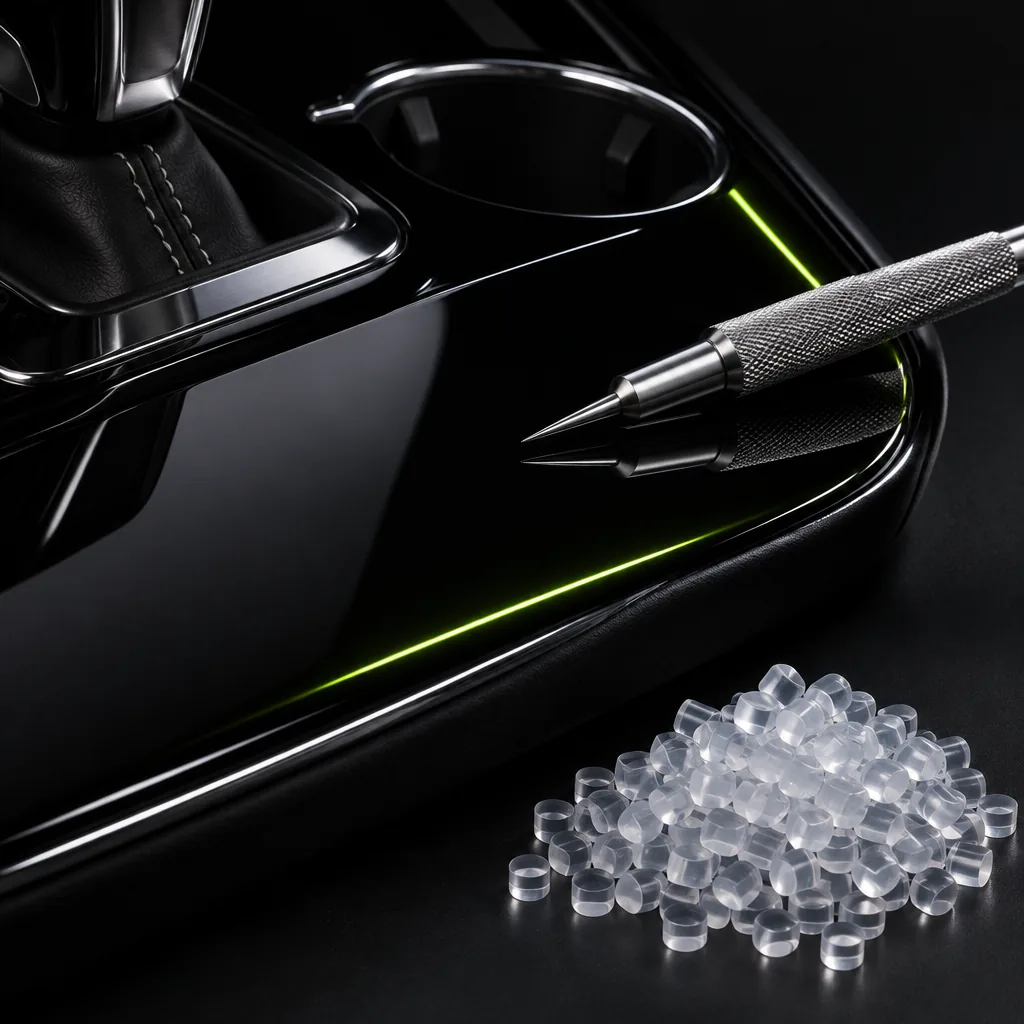
In automotive interior trim parts, home appliance control panels, piano black housings, furniture accessories, and consumer plastics subject to intensive daily contact, surface quality directly determines the perceived quality of the product. Talc-filled polypropylene (PP), TPO, ABS, and dark-colored plastics in particular scratch easily from fingernails, keys, assembly tools, or transport friction, producing a conspicuous whitening mark (stress whitening) along the scratch line.
The Erk-Han Anti-Scratch Masterbatch series comprises advanced surface protection concentrates developed with ultra-high molecular weight siloxane (UHMW Siloxane) technology; they are non-migrating and leave no greasiness or tackiness on the surface. Without compromising the mechanical strength of the part, they permanently lower the surface coefficient of friction (COF), increase scratch resistance, and fully meet OEM (automotive and home appliance) standards.
Explore all our product groups on the Erk-Han homepage.
Erk-Han Anti-Scratch Masterbatch Technologies
1. Permanent Series Based on Ultra-High Molecular Weight Siloxane (UHMW Siloxane)
Working PrincipleVery long-chain siloxane molecules anchored within the polymer matrix form a permanent, slippery protective layer on the part surface at the microscopic level. Unlike conventional low molecular weight fatty acid amides, they do not migrate to the surface and evaporate over time, nor do they leave a sticky layer.
Technical AdvantagesLong-lasting scratch resistance, zero surface greasiness (non-tacky), low odor, and low VOC (volatile organic compound) / fogging values.
Recommended ApplicationsAutomotive dashboards, door panels, center consoles, pillar trims, home appliance housings, and dark-colored technical parts requiring a long service life.
2. Special Series for Automotive Interior Trim and Talc-Filled PP / TPO
Working PrincipleOptimized for talc- and mineral-filled PP/TPO compounds to minimize the whitening mark (stress whitening) caused by separation of the mineral-polymer interface at the moment of scratching, as well as ΔL lightness deviation.
Technical AdvantagesLow ΔL values in demanding automotive OEM cross-hatch scratch tests (PV 3952, Erichsen, Five-Finger), faithful replication of in-mold texture (grain) details, and odor-free interior performance.
3. High-Gloss (Piano Black / High-Gloss) and Optical Surface Series
Working PrincipleIncreases micro-scratch (mar resistance) resistance on ABS, PC/ABS, PMMA, and glossy PP surfaces without reducing gloss and without creating haze.
Recommended ApplicationsTV and monitor bezels, air conditioner and washing machine front panels, small household appliances, cosmetic caps, and luxury packaging.
Working PrincipleCombines a dark-colored or black masterbatch formulation with anti-scratch and UV stabilizer additives in a single pellet.
Technical AdvantagesEliminates dosing errors, simplifies inventory management, and secures both lightfastness and scratch resistance in a single step.
Key Benefits for Your Production Operation
Permanent Scratch and Abrasion ResistanceUnlike conventional erucamide/oleamide slip agents, its effect does not fade within weeks; surface protection lasts throughout the entire service life of the product.
Prevention of Whitening Marks (Stress Whitening)Dramatically reduces the unsightly white scratch appearance caused by fingernail or hard-object contact, especially on black, anthracite, and dark gray parts.
Grease-Free, Dry, Dust-Repellent SurfaceDoes not create blooming, a greasy film, or a sticky feel on the surface; prevents dust and dirt pickup.
Low VOC and Fogging (Automotive Compatible)Does not cause window fogging or an unpleasant plastic odor under solar heat inside the vehicle.
Production and Mold Benefit (Process Support)Provides a mold release effect, helping parts eject from textured/grained molds without scratching or sticking; supports melt flow and reduces injection pressure.
Cost Advantage (Coating and Paint Savings)Eliminates the need for expensive hard varnish, protective lacquer, or post-painting operations applied for scratch resistance.
Main Applications and Target Industries
Automotive IndustryInstrument panels, glove boxes, inner door panels, center consoles, A/B/C pillar trims, trunk trims, seat backs, and sill trims.
Home Appliances and Small Household AppliancesWashing machine/dishwasher control panels, refrigerator inner shelves and crisper drawers, vacuum cleaner housings, coffee machine and food processor outer casings.
Electrical-Electronics and FurnitureSocket/switch frames, modem and TV housings, plastic armrests for office furniture, drawer rails/accessories, and profile claddings.
Luggage, Packaging, and HousewaresHard-shell ABS/PP/PC suitcases, cosmetic jars and caps, premium storage containers, transport crates, and garden furniture.
Cable and Pipe/Profile ExtrusionOuter cable jackets exposed to frictional scratching during pulling and installation, window/door profiles, and decorative WPC/PVC wall panels.
Supported Polymer Carriers
Erk-Han Anti-Scratch Masterbatches are produced with polymer-specific carriers to preserve the mechanical properties and optical surface quality of the base polymer:
Styrenics and Engineering PlasticsABS, HIPS, PS, PC/ABS, PC, PMMA, PA (Polyamide), POM, PBT, PET, and PVC
Erk-Han Laboratory Assurance
Every batch of Erk-Han Anti-Scratch Masterbatch undergoes performance and quality control in our laboratory before mass production:
Spectrophotometric ΔL (Color/Lightness Deviation) MeasurementPrecise measurement of the whitening change on the surface before and after scratching.
Surface Gloss and Optical InspectionVerification that the targeted surface texture is preserved on high-gloss or matte grained parts.
MFI / MVR and Thermal Stability TestConfirmation of stable process performance at processing temperature without degradation, smoke, or color change.
Dispersion and Pellet Homogeneity InspectionInspection of homogeneous siloxane distribution that causes no marks, flow lines, or phase separation on the surface.
Instrument panels, inner door panels, center consoles and pillar trims
Washing machine and dishwasher control panels, refrigerator shelves and crisper drawers
Socket and switch frames, modem and TV housings, office furniture armrests
Hard-shell ABS, PP and PC suitcases, cosmetic jars and caps
Outer cable sheaths, window and door profiles, decorative WPC and PVC wall panels
Affected Properties / Effects on the Final Product
Scratch and abrasion resistance: The effect does not fade within weeks; surface protection lasts throughout the service life of the product.
Whitening marks: Markedly reduces the white scratch marks left by fingernails or hard objects on black, anthracite and dark gray parts.
Surface feel: Causes no blooming, greasy film or tackiness on the surface; does not attract dust or dirt.
Fogging and odor: Causes no window fogging or unpleasant plastic odor inside the vehicle under solar heat.
Need for coating: Eliminates the need for hard coats, protective lacquers or post-painting applied for scratch resistance.
Effect on the Process and Production Line
Thanks to its mold release effect, parts eject from textured and grained molds without scratching or sticking.
Supports melt flow and lowers injection pressure.
Frequently Asked Questions
Page-specific technical questions and answers about Anti-Scratch Masterbatch.
What is Anti-Scratch Masterbatch?
It is a high-performance additive concentrate used to lower the surface coefficient of friction of plastic products, increasing their resistance to scratching, abrasion, and whitening marks (stress whitening) caused by fingernails, metal, assembly contact, and transport friction.
Why do plastic surfaces scratch easily, and why does the scratch look white?
When a hard object is pressed against a plastic surface, high friction creates microscopic tears and voids (micro-cracks) on the surface. In polymers such as talc-filled PP in particular, this deformation scatters light differently, making the scratch line appear bright white (stress whitening).
How does Anti-Scratch Masterbatch work?
During injection molding or extrusion, the active siloxane components orient toward the part surface and form a very thin, low-friction, slippery layer. When a hard object contacts the surface, instead of digging into the plastic and tearing its surface, it slides over this slippery layer, so no visible scratch or whitening occurs.
What is UHMW Siloxane (Ultra-High Molecular Weight Siloxane) technology?
It is a new-generation scratch prevention technology obtained by homogeneously dispersing silicone polymers of very high molecular weight in a carrier resin. Because it is physically interlocked with the polymer chains, it does not exude, become greasy, or evaporate from the surface over time.
What is the difference between conventional slip additives (erucamide/oleamide slip) and UHMW Siloxane anti-scratch additives?
Fatty acid amides (erucamide, oleamide) work by migrating to the surface; over time they leave a greasy/sticky layer (blooming) on the surface, attract dust, evaporate at high in-vehicle temperatures (under the sun) causing window fogging, and their scratch protection is lost quickly. The Erk-Han UHMW Siloxane series, by contrast, does not migrate, does not become greasy, causes no odor/fogging, and provides permanent protection.
Yes. When used at the correct dosage and with a suitable polymer formulation, the Erk-Han Anti-Scratch series developed for automotive interior trim parts meets the low ΔL values required by OEM scratch criteria such as the Erichsen cross-hatch scratch test (PV 3952), the Five-Finger test, and FLTM BN 108-13.
What does the ΔL (Delta L) value mean in scratch tests?
ΔL is the difference between the lightness/darkness value (L*) of a plastic surface before scratching and its lightness value after being scratched under a standard load (for example 10 N or 15 N). Especially on black and dark-colored parts, the closer the ΔL value is to zero (typically ΔL < 1.0 or < 1.5), the less visible the scratch is to the eye.
How is the Erichsen (Cross-Hatch) test performed?
A standard metal tip is moved across the plastic part surface with a defined force (for example 5 N, 10 N, or 15 N) to create a grid (cross-hatch) pattern. The color/lightness deviation (ΔL) of the scratched area is then measured with a spectrophotometer to rate the scratch resistance of the surface.
What is the Five-Finger scratch test?
It is a test method used especially in the automotive and home appliance industries, in which 5 standard metal tips loaded with different weights are drawn simultaneously across the sample surface to determine at which force in newtons (N) a visible scratch or whitening begins.
Why do talc-filled PP parts (10%, 20%, 30% talc) scratch more easily, and how is this solved?
Talc filler increases the stiffness and heat resistance of the plastic, but when a hard object rubs against it, the talc particles separate from the polymer matrix and leave an intense white mark. Erk-Han UHMW siloxane masterbatches specifically designed for talc-filled PP/TPO lower the coefficient of friction and largely prevent this whitening.
What is the recommended usage rate (dosage) in percent?
Depending on the base polymer, filler content, surface texture, and target scratch force (for example 10 N vs. 15 N), it is generally used in the range of 1.0% to 4.0%. A dosage of 1.5–2.5% is commonly preferred for standard housewares and home appliances, and 2.0–4.0% for demanding talc-filled automotive interior trim applications.
Does increasing the dosage beyond what is needed continuously improve scratch resistance?
No. Significantly exceeding the optimum dosage (above 4–5%) brings no additional gain in scratch resistance, raises costs unnecessarily, and in some polymers may cause layer separation (delamination), surface flow marks, or difficulties with printing/bonding.
Does the anti-scratch additive reduce gloss on glossy black (Piano Black) surfaces?
Produced with the correct carrier and high dispersion, the Erk-Han Anti-Scratch series preserves the high surface gloss of ABS, PC/ABS, and glossy PP parts at recommended dosages (1–2.5%); it does not cause dulling or haze.
Does it undesirably increase surface gloss in matte or grained (textured) molds?
No. It works without disturbing the low-gloss (matte grain) texture required especially in automotive dashboards and door panels, and supports sharp replication of the mold texture.
Does it cause haze in transparent polymers (PC, PMMA, SAN, transparent PP, PET)?
Because the refractive index of siloxane differs from that of some transparent polymers, slight haze may occur at high dosages. In transparent applications, clarity is preserved with an optimum low dosage (0.5–1.5%) and special Erk-Han formulations with a matched refractive index.
Does Anti-Scratch Masterbatch leave a greasy or sticky feel on the surface?
Absolutely not. Erk-Han UHMW siloxane-based products have a non-migrating structure; the part surface remains completely dry, smooth, and silky to the touch, with no greasy feel on hand contact.
Will white dusting or blooming appear on the surface over time?
Conventional low-cost amide-based slip agents form a white hazy layer (blooming) on the surface after a few weeks. In the ultra-high molecular weight siloxane-based Erk-Han series, the molecules are anchored within the polymer, so blooming absolutely does not occur during warehouse storage or on hot summer days.
Does it cause odor and window fogging (VOC / Fogging) in automotive interiors?
No. Because it is formulated with low-volatility, high-purity siloxane raw materials, it complies with in-vehicle VOC emission and fogging (DIN 75201 / VDA 278) requirements and does not create odor.
Does the use of Anti-Scratch Masterbatch affect painting, screen printing, pad printing, or bonding?
Because siloxane lowers surface tension, at high dosages it may reduce the direct adhesion of paint, ink, or adhesive. However, since UHMW siloxane does not spread across the surface like conventional silicone oils, printing and bonding can be successfully carried out at low-to-medium dosages and, if necessary, with corona/plasma/flame surface treatment. An adhesion test (cross-cut) on a sample before production is recommended.
Does it adversely affect ultrasonic welding or vibration welding?
In the recommended dosage range (1–3%), it generally has no significant adverse effect on weld strength. For parts with critical automotive or home appliance weld points, the optimum dosage is verified by a weld tensile test after pilot injection molding.
Does the anti-scratch effect start as soon as the part is ejected from the mold, or is a waiting period required?
While migrating amide additives require 24–72 hours for the effect to settle, Erk-Han UHMW Siloxane-based anti-scratch additives position themselves at the surface immediately during mold filling, so they provide full protection from the moment the part cools (even on the assembly and packaging line).
Does Anti-Scratch Masterbatch reduce the mechanical strength of the part (impact, tensile)?
At recommended usage rates, the tensile strength and flexural modulus of the base polymer are preserved; in many PP and ABS applications, a slight improvement in impact strength (Izod/Charpy) is even observed thanks to the internal lubricating and stress-distributing effect of siloxane.
Does it lighten the color or cause a shade shift in black and dark-colored parts?
At usage levels of 1–3%, it does not alter black and dark color shades; on the contrary, it supports pigment dispersion and helps achieve a more homogeneous and deeper surface appearance.
Can Anti-Scratch Masterbatch be used together with color masterbatch?
Yes. It can be dosed simultaneously at the machine throat together with your existing black, white, or color masterbatch. If you prefer, we can also produce it in the Erk-Han laboratory as a combined masterbatch that unites color and the anti-scratch additive in a single pellet.
In which polymers can Erk-Han Anti-Scratch Masterbatch be used?
It can be used with polymer-specific carriers in virtually all thermoplastics, including PP (homopolymer, copolymer, talc/glass fiber filled PP), TPO, HDPE, LDPE, ABS, HIPS, PS, PC/ABS, PC, PMMA, PA (Polyamide), POM, PBT, PET, TPE/TPV, and PVC.
Why is carrier resin selection so important in anti-scratch masterbatch?
If the carrier resin is incompatible with the base polymer, flow lines, layer separation (peeling/delamination), and mechanical weakness occur in the mold. For example, a PE-carrier anti-scratch additive should not be added to an ABS or PC/ABS part; a Erk-Han series with a carrier compatible with the respective polymer must always be selected.
Is it necessary to change process parameters in injection molding?
Generally, no major adjustment is required. In fact, thanks to the flow-enhancing effect of siloxane, injection pressure can be reduced by 5–15%, the use of mold release spray decreases because ejection becomes easier, and cycle time is shortened for some parts.
Does high back pressure or screw speed degrade the anti-scratch additive?
High molecular weight siloxane is highly stable thermally and mechanically. It does not degrade at normal injection and extrusion screw speeds; balanced back pressure helps the siloxane disperse homogeneously in the melt.
Can it be used in hot runner molds?
Yes. With its fully melting structure free of solid abrasives, it passes smoothly through hot runner systems and fine nozzles without clogging, and it also helps reduce flow resistance inside the hot runner.
What does anti-scratch additive bring to extrusion lines (sheet, profile, cable jacket)?
In the extrusion of sheet (ABS/PMMA/PP/HIPS), luggage sheet, profiles, and cable jackets, it provides high scratch/abrasion resistance on the final surface while also reducing friction inside the die, lowering head pressure, reducing die build-up, and increasing line speed.
In multilayer (co-ex) sheet and profile production, should it be added to all layers?
No. Since scratching occurs only on the outer surface, in multilayer sheets, luggage sheets, or profiles it is sufficient to add the anti-scratch masterbatch only to the outermost (skin/cap) layer. This method reduces costs significantly.
What is its effect in hard-shell luggage production (ABS, PP, PC sheet/injection)?
Luggage is exposed to heavy impact and friction at airports and on conveyor belts. Using Erk-Han Anti-Scratch in the outer surface layer helps the suitcase retain its new look for a long time and reduces white scratch marks on dark colors such as black and navy.
Why is it preferred in home appliances and small household appliances?
Refrigerator shelves, crisper drawers, washing machine front panels, and vacuum cleaner housings are constantly exposed to friction both during assembly/transport and in household use. Anti-scratch masterbatch prevents in-package friction scratches and user-induced surface deformation, reducing return/warranty rates.
Does Anti-Scratch Masterbatch increase the static electricity (dust attraction) problem of the part?
No. While conventional greasy surfaces attract dust like a magnet, dry-surface UHMW siloxane technology does not trigger dust adhesion. For home appliance and electronic parts requiring extra dust repellency, it can be used in combination with Erk-Han Antistatic Masterbatch.
Does it work together with UV stabilizers in outdoor products?
Yes. In garden furniture, automotive exterior trim, agricultural equipment, and outdoor profiles, it works in full compatibility with Erk-Han UV & Light Stabilizer masterbatch; it does not cause yellowing or performance loss under UV radiation.
Does it improve the surface appearance of glass fiber reinforced (PP GF30, PA6 GF30) parts?
Yes. In glass fiber filled parts, it helps soften the rough glass mark (fiber blooming) appearance on the surface, reduce mold wear, and achieve a smoother, more scratch-resistant surface.
Is Anti-Scratch Masterbatch effective in recycled (PCR / regrind) raw materials?
Yes. The surfaces of recycled PP, ABS, and HDPE raw materials are generally more prone to scratching and whitening. Using Erk-Han Anti-Scratch Masterbatch gives parts made from recycled raw material a surface quality and ease of flow close to those of virgin raw material.
Does it cause problems when production scrap (runners/flash) is reground and fed back into production?
No. Because UHMW siloxane is thermally stable, runners and flash that are reground and fed back into production do not cause degradation, burning, or black specks; on the contrary, it supports the flowability of the regrind material.
Is there a difference between fingernail scratches and deep metal/key scratches?
Fingernail scratches mainly create superficial abrasion and whitening (mar/whitening); with the correct dosage they can be made almost 100% invisible. For deep metal and sharp blade impacts, although no polymer is completely cut-proof, Erk-Han Anti-Scratch significantly reduces the scratch depth, edge raising, and whitening contrast.
Does the mold surface (glossy vs. rough/grained) affect scratch performance?
Yes. Deep, sharp-edged matte mold textures (grains) are more prone to whitening as micro-peaks are crushed when a fingernail rubs against them. For this reason, using Erk-Han Anti-Scratch at the correct dosage in grained automotive and home appliance molds makes a much more pronounced difference compared to glossy surfaces.
Can it be used in food contact products (kitchenware, refrigerator shelves, packaging)?
Yes. We offer options formulated with food-contact-suitable carriers and high-purity siloxane raw materials that comply with the relevant food contact regulations (EU 10/2011, FDA). Simply state the food contact requirement at the inquiry stage.
Does Erk-Han Anti-Scratch Masterbatch comply with REACH, RoHS, and IMDS requirements?
Yes. None of our formulations contain heavy metals or restricted SVHC substances; they fully comply with REACH and RoHS regulations. The technical documentation and declarations of conformity required for automotive supply chain projects are provided.
What is the active siloxane content in Anti-Scratch Masterbatch?
Depending on the application and polymer, Erk-Han offers high-concentration pellet formulations that generally contain between 25% and 50% active UHMW siloxane. Thanks to the high active concentration, maximum efficiency is achieved at low dosages.
Why should I use pelletized Anti-Scratch Masterbatch instead of liquid silicone oil?
Liquid silicone oils cause slippage at the machine feed throat (screw feeding problems), dosing fluctuations, slippery floor hazards in the production area, severe surface greasiness, and printing/paint contamination. Pelletized Erk-Han UHMW Siloxane Masterbatch, on the other hand, is clean, safe, homogeneously dosable, and permanent.
Does it cause gas buildup or mold deposits (plate-out) in the mold?
Low-quality additives containing paraffin or excessive amide form waxy deposits (plate-out) on the mold surface. High-purity Erk-Han UHMW Siloxane Masterbatches do not build up on the mold surface; on the contrary, they support clean release of the part from the mold.
How should the machine be cleaned after using Anti-Scratch Masterbatch?
During standard production changeovers, the barrel can be emptied with virgin raw material. However, if the next production run is silicone-free and requires direct painting or sensitive bonding, a thorough cleaning with Erk-Han Machine and Screw Cleaner (Purging Compound) is recommended so that no trace of siloxane remains in the barrel and check valve.
What are the storage conditions and shelf life?
It should be stored in its original, sealed packaging in a cool, dry, enclosed warehouse away from direct sunlight. When stored under suitable conditions, it has a shelf life of at least 24 months without performance loss.
Is drying required before use?
PP- and PE-carrier series do not absorb moisture and therefore require no drying. However, for hygroscopic engineering series with ABS, PC/ABS, PA, or PET carriers, drying at around 70–80 °C for 2–4 hours, in line with the base polymer, gives the cleanest surface quality.
How can we quickly test in our plant that the scratch resistance of our part has increased?
Mold samples from the same tool without additive (reference) and with 2–3% Erk-Han Anti-Scratch added, condition them at room temperature for 24 hours, then scratch them side by side with a constant-weight scratch device (or a standard cross-hatch test kit) to clearly compare the whitening difference (ΔL) both visually and with a spectrophotometer.
How can we select the most suitable Erk-Han Anti-Scratch Masterbatch for our project and obtain a sample?
Simply share your base polymer (for example 20% talc-filled PP, ABS, PC/ABS, etc.), the part color, surface type (glossy or grained), the target OEM test standard if any, and your production process via the contact channels on our website or our WhatsApp technical support line. Erk-Han engineers will determine the most suitable series for your project and send you a sample and the technical data sheet (TDS).
Raise Your Quality Standards with Permanent, Non-Greasy Surface Protection
Contact our technical team now for a sample of Erk-Han Anti-Scratch Masterbatch, which puts an end to scratches and whitening marks on all your automotive, home appliance, and dark-colored high-gloss plastic parts.