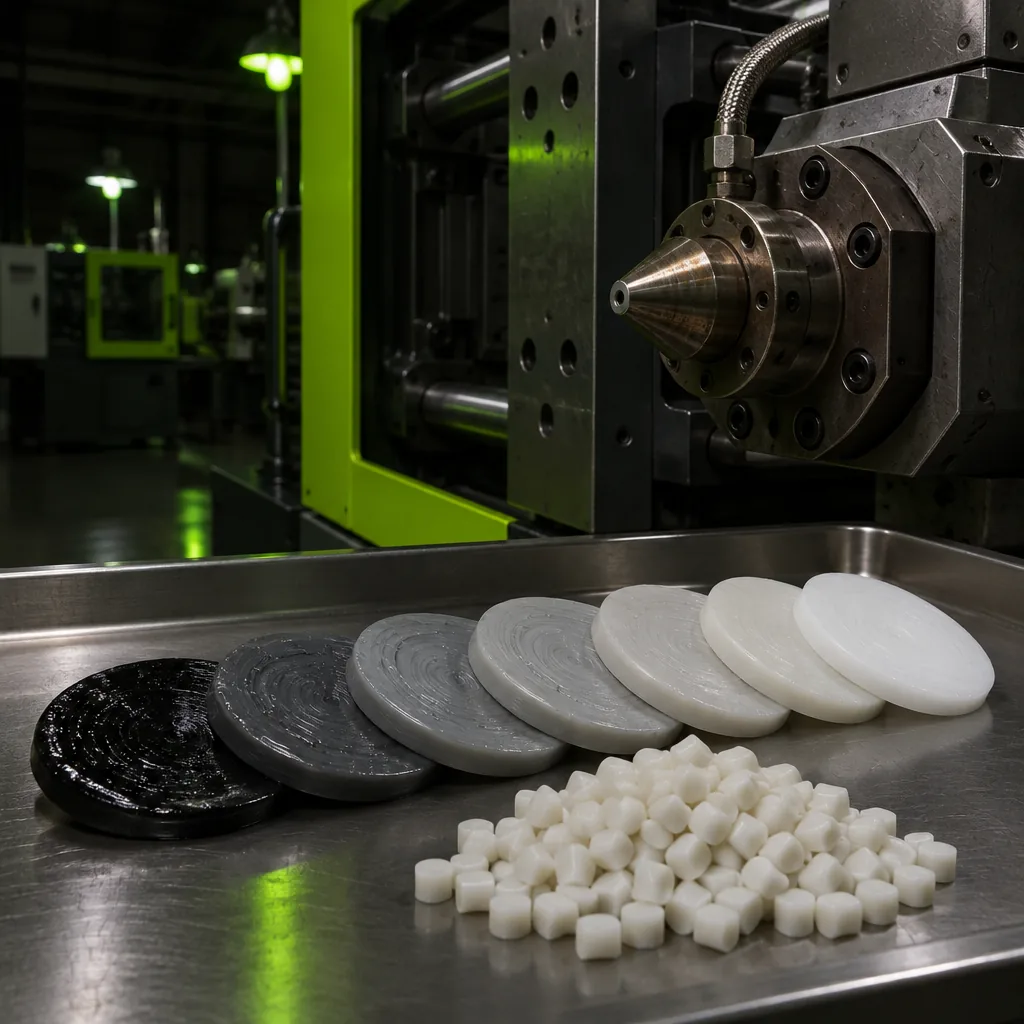
In plastics processing plants, one of the biggest hidden cost items is the combination of long machine stoppages during color and material changeovers, bags of changeover scrap, and black speck defects caused by burnt (carbonized) residues building up on the screw/barrel surface. Conventional cleaning with standard natural polymer (resin) both takes hours and fails to completely remove old color left in dead spots in the barrel, check valve and hot runner corners.
The Erk-Han Machine and Screw Purging Compound series consists of advanced-technology cleaning granules specially formulated for injection, hot runner, blown/cast film, pipe, profile and blow molding machines, providing deep cleaning without damaging the barrel and screw. In black-to-white or dark-to-transparent changeovers, it reduces downtime and changeover scrap by 50% to 80%, directly increasing your production efficiency.
Explore all our product groups on the Erk-Han homepage.
Erk-Han Machine and Screw Purging Compound Types
1. Chemically Active Purging Compound (Chemical Purging Compound)
Working PrincipleOnce processing temperature is reached, the active cleaning components engage chemically; they weaken the molecular bonds of old pigment, additive and burnt polymer layers stuck to barrel, screw and hot runner surfaces and strip them from the surface.
Technical AdvantagesBecause it contains no solid abrasive minerals, it passes safely through narrow-channel hot runner systems, valve pins and fine nozzles.
Recommended ApplicationsHot runner injection molds, thin-wall packaging, changeovers to transparent parts (PET, PC, PMMA, clear PP) and sensitive medical/optical production.
2. Mechanical and Hybrid (Chemical + Mechanical) Purging Compound
Working PrincipleCombines controlled chemical dissolving power with a soft mineral scrubbing action that does not scratch the metal surface (non-abrasive).
Technical AdvantagesDelivers maximum stripping power for heavy carbonization, severe black speck problems, screws that have not been cleaned for a long time and demanding dark-to-white changeovers.
Recommended ApplicationsStandard injection molding machines, pipe, profile, sheet and film extrusion lines, and blow molding machines (including accumulator-head types).
Working PrincipleProduced with special high-heat carriers that remain stable at high processing temperatures without smoke, odor or self-ignition.
Recommended ApplicationsColor/material changeovers of PA (polyamide / nylon), PC (polycarbonate), PET, PBT, POM, PPS, PSU and glass-fiber-reinforced engineering plastics.
4. Machine Shutdown and Protection (Shutdown / Sealing) Solution
Working PrincipleLeft in the barrel over weekends, at shift ends or during long stoppages, it cuts off contact between air (oxygen) and the hot metal and polymer residues.
Technical AdvantagesPrevents oxidation-related black specks and burning when the machine is reheated, enabling a fast and clean return to production at the first morning start-up.
Key Benefits for Your Production Plant
50–80% Shorter Changeover TimeReduces color and material changes that take hours to minutes, increasing your overall equipment effectiveness (OEE).
Major Savings in Raw Material LossEliminates the tens of kilograms of expensive production resin spent cleaning the barrel; the cost of the purging compound stays far below the material and time saved.
Definitive Solution to Black Specks and Burn MarksStrips carbonized residues that accumulate in dead spots on screw flights, the check valve (non-return ring), the nozzle and the die head.
Reduces the Need to Pull the ScrewWith periodic use it prevents build-up inside the barrel, significantly reducing how often machines must be dismantled for mechanical cleaning and the maintenance labor involved.
Complete Safety for Chrome-Plated Screws and BarrelsFormulated with components far softer than barrel/screw steel, so it causes no wear, scratches or loss of tolerance.
Low-Odor, Smoke-Free OperationProduced with safe formulations that protect operator health and air quality in the production area.
Main Applications and Processes
Injection Molding (Cold and Hot Runner)Dark-to-white/transparent changeovers, check valve cleaning, and color changes inside hot runner manifolds and nozzles.
Film Extrusion (Blown and Cast Film)Removal of burnt material, gels and black specks inside the die and color changes on multilayer (co-ex) and monolayer film lines.
Pipe, Profile and Sheet ExtrusionFast changeover from black or dark shades to light colors and die head cleaning on PE100, PPRC, PVC and ABS/PS lines.
Blow MoldingRemoval of dead spots and streaks (color traces) on accumulator-head and continuous-extrusion blow molding lines.
Compound and Masterbatch ProductionClean, fast changeover from heavily pigmented batches to light-colored batches on twin-screw extruders.
Basic Application Steps (Quick Field Guide)
On Injection Molding Machines
Empty the current production material completely from the barrel and clean the feed hopper.
Retract the injection unit from the mold (if the hot runner is not being cleaned).
Feed Erk-Han Purging Compound directly (unmixed) into the hopper in an amount of roughly 1 to 2 times the machine's barrel capacity.
Set back pressure to medium-low and screw speed to medium-high, and shoot the material in short intervals. If there is heavy carbonization, let it soak in the barrel for 3–5 minutes, then purge it out at high speed.
When the melt comes out completely clean, feed the new production material to flush the purging compound out of the barrel and start series production.
On Extrusion Lines
Lower the machine pressure to a safe level; if you are using a mechanical/hybrid purging compound, always remove the fine screen pack.
As the previous material runs out, feed Erk-Han Purging Compound and gradually raise and lower the screw speed (surging effect) to accelerate the removal of layers inside the barrel.
When the material leaving the die is clean, feed the new material and purge out the compound completely, then install a new screen pack and start production.
Erk-Han Laboratory Assurance
Every batch of Erk-Han Machine and Screw Purging Compound is tested in our laboratory for high performance and equipment safety:
Thermal Stability CheckVerification that it does not self-ignite, gas excessively or produce odor within the specified temperature window.
Stripping Power and Residue-Free TestChecks of dark-to-white changeover performance and easy flushing with new material on pilot extruder and injection lines.
Food Compliance and Chemical SafetyVerification of composition against the relevant food-contact, REACH and RoHS requirements.
Dark-to-white and dark-to-transparent changeovers in injection molding, hot runner and nozzle cleaning
Removal of burnt material, gels and black specks inside the die on blown and cast film lines
Dark-to-light color changeovers on PE100, PPRC, PVC and ABS/PS pipe, profile and sheet lines
Removal of color traces on accumulator-head and continuous-extrusion blow molding lines
Changeovers from heavily pigmented to light-colored batches on twin-screw extruders
Affected Properties / Effects on the Final Product
Black specks and burn marks: Strips carbonized residues from the screw, check valve, nozzle and die head, so no black specks are carried into the product.
Color cleanliness: No traces or streaks of the previous color remain in the new batch.
Gels and surface defects: Eliminates surface defects caused by gels and burnt material inside the die on film and sheet lines.
Screw and barrel surface: Works with components softer than barrel and screw steel; causes no wear, scratches or loss of tolerance.
Working environment: The low-odor, smoke-free formulation protects operator health and air quality in the production area.
Effect on the Process and Production Line
Color and material changeover time is cut by 50% to 80%, increasing machine utilization.
Eliminates the loss of base resin otherwise used to flush the barrel.
Used periodically, it prevents build-up; screw pulls and maintenance labor are reduced.
Frequently Asked Questions
Page-specific technical questions and answers about Machine and Screw Purging Compound.
What is a Machine and Screw Purging Compound?
It is a cleaning compound in granular form, specially developed to quickly and safely strip old color, polymer and carbonized burnt residues that accumulate on the screw, barrel, check valve, nozzle and die heads of plastics processing machines (injection molding, extrusion, blow molding).
Why should I use a Purging Compound instead of cleaning with standard natural resin (e.g. clear PP or HDPE)?
Natural polymers cannot dissolve the pigment and burnt layers stuck to the barrel wall; they simply flow over them. That is why a dark-to-white changeover with natural resin takes hours, wastes tens of kilograms of material, and old color streaks or black specks keep appearing in parts even hours after production has started. Erk-Han Purging Compound detaches the adhered layers from the surface chemically and physically and expels them in a single pass.
Does a Purging Compound scratch the machine's screw, barrel or chrome plating?
No. Erk-Han Machine and Screw Purging Compound products are formulated with non-abrasive components whose Mohs hardness is far lower than that of barrel and screw steel (and of hard chrome/nitrided coatings). They never damage the metal surface.
What is the difference between a chemical and a mechanical purging compound?
Chemical purging compounds are activated by heat and weaken the bonds by which old polymer and pigment adhere to the metal surface; since they contain no solid minerals, they pass safely through hot runners. Mechanical (or hybrid) purging compounds physically scrub the screw and barrel surface with soft mineral particles; they are particularly effective against heavy carbonization and severe black specks.
Can a single purging product be used on all machines and all plastics in the plant?
General-purpose Erk-Han purging compounds cover the great majority of polyolefins and styrenics (PE, PP, PS, ABS, PVC, TPE) in the 160 °C – 280 °C range with a single product. However, for high-temperature engineering plastics processed above 280 °C, such as PC, PA, PET, PBT and PSU, or for narrow-channel hot runners, special high-heat / chemical grades should be used.
How much raw material and time does a Purging Compound save?
When applied correctly, color and material changeover times are reduced by 50% to 80% on average. A black-to-white changeover that requires 50–100 kg of material loss and 2 hours of downtime with natural polymer is usually completed in 15–25 minutes with 3–8 kg of purging compound.
How much purging compound needs to be fed into the machine for one cleaning?
The general rule is to use a volume of purging compound equal to 1 to 2 times the barrel (shot) capacity of the injection molding machine. For heavy carbonization or very dark pigment changeovers, this amount can rise to 2.5–3 barrel volumes. On extrusion lines, it is determined by screw diameter and die head volume.
Is a Purging Compound mixed with the production resin or used neat (100%)?
Erk-Han Purging Compound products are ready-to-use and are fed directly at 100% without mixing with any resin. Diluting with production resin lowers the cleaning power. (Only concentrated purging additive grades are mixed with a carrier polymer at the specified ratio.)
After the Purging Compound cleans the barrel, does it leave its own residue behind?
No. The viscosity and carrier system of the purging compound are designed so that it is easily pushed and completely expelled from the barrel by the new production material that follows. After cleaning, 2–3 short purges with the new material are sufficient.
How do you get the best result when changing from black to white or from dark red to transparent?
First, the current dark material is completely emptied from the barrel, and the hopper and feed throat are cleaned with air/a cloth. Then Erk-Han Purging Compound is fed at 1.5–2 times the barrel volume, a short soaking period is applied, and it is purged out at high screw speed. If necessary, once the barrel is clean, it is rinsed with the new white/transparent material as a final step.
Does a Purging Compound solve sudden "black speck" (carbonization) problems in parts?
Yes. Black specks are pieces of polymer/pigment that have remained for a long time on the barrel wall, screw flights, behind the check valve or at the nozzle tip, burned, and eventually break off into the product. Regular use of a Purging Compound strips these carbon layers before they harden, eliminating losses caused by black specks.
Is a Purging Compound enough instead of dismantling the machine and pulling the screw?
In a plant where it is used regularly (e.g. weekly or at every color change), it largely eliminates the need to pull the screw. However, machines that have not been cleaned for years and have heavy, hardened carbon deposits inside the barrel may initially require mechanical dismantling or several cycles of intensive chemical-mechanical cleaning (including soaking).
Can a Purging Compound be used in hot runner molds?
Yes, but for hot runners a hot-runner-compatible chemical or low-viscosity Erk-Han Purging Compound grade without solid abrasives must be selected. Standard high-mineral mechanical purging compounds can clog narrow hot runner nozzles.
What should the nozzle diameter (gate size) be when cleaning a hot runner?
Our hot-runner-compatible chemical purging compounds pass safely through standard hot runner nozzles above 0.5 mm – 0.8 mm and through valve-gate systems. For very narrow micro nozzles (<0.5 mm), approval and a special formulation recommendation should be obtained from the Erk-Han technical team before application.
When cleaning a hot runner, is the material injected into the mold or purged outside?
In hot runner cleaning, the injection unit (barrel and screw) is first retracted from the mold and purged into the open. Once the barrel is completely clean, the unit is brought back against the mold, and with the mold in an open or half-open safety position (or with a suitable purge fixture/low-shot part molding), the purging compound is passed through the hot runner manifold and nozzles to clean them.
What should the back pressure be when purging an injection molding machine?
In general, low-to-medium back pressure (e.g. half of standard production or around 5–15 bar) is applied while the purging compound is being loaded into the barrel, in order to increase friction and scraping force on the screw and barrel surface. Excessively high back pressure can suppress the gassing of a chemical purging compound, while zero back pressure can reduce the scraping effect.
Should screw speed (RPM) be kept high or low during purging?
While the purging compound is loaded into the barrel, a medium-high screw speed creates high shear to mechanically break away deposits on the barrel wall. In the injection (shooting) phase, expelling the material from the barrel quickly at high injection speed also gives the best cleaning.
What is "soaking" and when should it be applied?
After the barrel is filled with purging compound, the machine is stopped and left at temperature for 3 to 10 minutes so the active chemicals can penetrate the carbon and pigment layers. It multiplies cleaning performance, especially for heavy burning, black specks and difficult color changes.
Does the purging compound cause damage if left in the barrel for too long?
The recommended 3–10 minute soaking time should not be greatly exceeded (e.g. leaving it at high heat for hours). Once the chemical reaction is complete, the material should be purged out at high speed. For long stoppages, a "shutdown/sealing" procedure is applied instead of soaking.
How is old color behind the check valve (check ring) of an injection molding machine cleaned?
The area behind the check valve is the hardest dead zone to clean. Moving the screw fully forward and back in short strokes during purging (short recovery and fast injection cycles) forces the purging compound through the check valve channels under high pressure and strips the old color in this area.
Should temperature settings be changed when purging an injection molding machine?
For most color changes there is no need to change the current operating temperature. However, when changing from a low-temperature polymer (e.g. PP) to a high-temperature polymer (e.g. PC/PA) or vice versa, the barrel temperatures are brought into the common safe window of the two polymers or into the working range of the purging compound for the changeover.
What procedure should be followed when changing from a high-temperature polymer (PC, PA, ABS) to a low-temperature polymer (PP, PE)?
First, the high-temperature polymer (e.g. PC at 280 °C) is completely expelled from the barrel with a heat-resistant Erk-Han Purging Compound. While the barrel is full of purging compound, the heaters are lowered to the temperature of the new polymer (e.g. PP at 200 °C). When the temperature reaches the target, the new polymer is fed to expel the purging compound. This way, the low-temperature polymer is not burned at high heat.
What should be done when changing from a low-temperature polymer (PP, PE) to a high-temperature polymer (PC, PA)?
The PP/PE running at low temperature is first emptied from the barrel with a purging compound at low/medium temperature; otherwise, when the temperature is raised to 280 °C, any PP/PE remaining in the barrel will burn and create severe black specks. After the barrel is clean, the temperature is raised and the changeover to the new engineering polymer is made.
Should the screen pack be removed when purging extrusion lines (film, pipe, profile, sheet)?
If you are using a mechanical or hybrid purging compound and the screen is finer than 100 mesh, it is recommended to remove the screen pack or fit a temporary coarser screen; otherwise large carbon pieces that are stripped off can quickly clog the screen and raise head pressure. With chemical purging compounds, the changeover can be made with medium-mesh screens while pressure is monitored continuously.
How are gels and black specks cleaned on blown and cast film lines?
On film extruders, the die lips and spiral distributor channels are very sensitive. A low-viscosity, residue-free Erk-Han Purging Compound designed for film lines should be used, and during purging the screw speed should be gradually raised and lowered to mobilize dead spots in the spiral channels.
How is purging applied on multilayer (co-ex) extrusion lines?
On multilayer lines, it is sufficient to feed purging compound only to the extruder that is changing color or producing black specks; however, if the main feedblock and die are to be cleaned, purging through all layer extruders simultaneously gives the fastest and cleanest result.
How is an old color streak (bleeding) inside the die removed on pipe and profile extrusion lines?
Old color can accumulate behind the spider legs in pipe and profile dies. While the purging compound passes through the die, lowering and raising the extruder speed in 1–2 minute cycles (speed surging) changes the pressure in these dead zones and completely strips the adhering pigments.
How is purging done on blow molding machines, especially accumulator heads?
On accumulator-head blow molding machines, the accumulator chamber should be completely filled with purging compound at least 2–3 times and emptied at maximum speed. This high-speed discharge scrapes off burnt residues accumulated on the chamber walls and the piston tip and expels them.
Can a Purging Compound be used on machines processing PVC (rigid or flexible)?
Yes, but PVC is very heat-sensitive and releases corrosive HCl gas when it degrades. On PVC lines, a special Erk-Han PVC Purging Compound that is fully chemically compatible with PVC and has a low processing temperature (150 °C – 200 °C) must be used.
What should be considered when purging machines that process POM (acetal)?
POM (polyacetal) must never come into contact with PVC or acidic additives in the same barrel; a violent chemical reaction and sharp gas release can occur. For POM changeovers, a POM-compatible, neutral/alkaline-balanced Erk-Han Purging Compound must be chosen and the temperature must not exceed 210 °C.
Does the purging compound cause haze when changing to transparent and optical parts (PC, PMMA, PET, clear PS/PP)?
When a correctly selected transparent/chemically compatible Erk-Han Purging Compound is used and the barrel is thoroughly rinsed with the new transparent material at the end of the process, no cloudiness, haze or optical marks remain.
How is a Purging Compound used when shutting down the machine at the weekend or end of shift (Shutdown / Sealing)?
When production ends, the last material is emptied from the barrel and the barrel is filled with Erk-Han Purging Compound. The heaters are switched off and the barrel is left to cool. Because the purging compound seals the barrel against the ingress of air (oxygen), polymer burning and black speck formation are prevented during cooling and reheating the next day.
What should be done when the machine is restarted after shutdown (sealing)?
Once the machine reaches normal operating temperature and the temperature has stabilized (soak), the sealing compound in the barrel is shot out at high speed and new production material is fed directly, so clean series production resumes within minutes.
Does a Purging Compound need to be dried before use?
General-purpose and polyolefin-based purging compounds require no drying and are fed directly from the bag. Even for high-temperature engineering grades, no pre-drying is needed when the moisture-barrier packaging is opened and used immediately; however, for product that has been left exposed, the instructions in the technical data sheet (TDS) should be followed.
Does a Purging Compound produce smoke or an unpleasant odor as it leaves the machine?
Erk-Han formulations are produced with operator safety in mind, following the principle of low volatility and minimal odor. However, if the product is used above its specified maximum operating temperature, slight vapor or odor may occur; it is always recommended that the barrel temperature be within the recommended range and that standard machine ventilation be switched on.
Can the purge discharged during cleaning be recycled or used as regrind?
Because the purge discharged during cleaning contains stripped old colors, carbonized black specks and active cleaning agents, mixing this waste back into quality production as regrind is not recommended. Waste management should be handled separately according to local recycling procedures.
Is a Purging Compound safe to use in plants producing food packaging and medical parts?
Yes. Erk-Han offers safe purging options whose components are selected from food-contact-compliant raw materials (FDA / EU 10/2011 referenced). When the barrel is fully flushed with new production material after cleaning, no residue remains.
Does Erk-Han Purging Compound comply with REACH and RoHS regulations?
Yes. All our purging formulations comply with REACH and RoHS restrictions; they contain no heavy metals or restricted SVHC substances.
Which is more advantageous: a liquid purging agent or a granular (solid) Purging Compound?
Liquid purging agents require an additional dosing pump, carry a risk of spillage/leakage and are harder for operators to handle. Granular Erk-Han Purging Compound, on the other hand, is poured directly into the hopper like standard plastic resin, does not dust or splash, and is very practical to store and dose.
Why is cleaning with homemade or standard calcite/resin mixtures risky?
High-calcite low-cost mixtures not only lack chemical stripping power but can also clog hot runner nozzles with uncontrolled coarse mineral particles, scratch the screw surface and contaminate new production with calcite/chalk marks. An engineered Purging Compound, by contrast, provides safe cleaning through a controlled particle structure and chemical synergy.
Does a Purging Compound work for changeovers from glass-fiber-reinforced materials (PA6 GF30, PP GF30, etc.)?
Yes. Glass-fiber-filled engineering plastics are highly prone to building up on the screw and check valve and to burning from high frictional heat. The Erk-Han high-temperature purging series safely flushes out glass fiber residues and burnt resin.
What happens if the hopper and vacuum loader are not cleaned during a color change?
Even if you clean the barrel perfectly with a Purging Compound, a few old black/red pellets stuck to the hopper wall by static electricity that later drop in will keep causing streaks in the new white product. For this reason, the hopper, throat and magnet must always be cleaned before the purging compound is fed.
Can it be used on twin-screw compounding and masterbatch extruders?
Yes. On twin-screw extruders, the high-shear-compatible Erk-Han Purging Compound series is extremely effective for fast color changes after heavily pigmented masterbatch production without dismantling the screws.
How often should a Purging Compound be used? Only when a problem arises?
Rather than using it only when black specks appear, it is recommended to include it in a preventive maintenance program. When used regularly at every color/material change and at weekly machine shutdowns, no carbon builds up inside the barrel and unplanned stoppages approach zero.
Does the purging compound foam or cause excessive pressure build-up inside the machine?
Chemical purging compounds may show a very slight, controlled expansion/foaming during active operation; this effect makes it easier to reach dead spots. Within the recommended temperature range and with the die/nozzle tip open, it does not create a dangerous pressure rise.
Should the machine be cleaned with a Purging Compound after using Foaming Masterbatch or a Flame Retardant (FR) additive?
Absolutely. Flame retardant (FR) and foaming additives in particular can cause corrosion or burning if they remain in the barrel at high heat. Cleaning the barrel with Erk-Han Purging Compound immediately after these production runs extends screw and barrel life.
What safety precautions should the operator take when using a Purging Compound?
Standard plastics processing safety equipment (heat-resistant gloves, safety goggles) should be used, the protective guard should be kept closed against hot melt splashing when the injection nozzle is retracted, and head pressure should be monitored closely during extrusion.
How should a Purging Compound be stored and what is its shelf life?
It should be stored in its original, sealed moisture-barrier packaging in a cool, dry, enclosed warehouse away from direct sunlight. When stored under suitable conditions, it has a shelf life of at least 12–24 months without loss of performance.
How can we measure in our plant whether a Purging Compound really saves money?
Simply perform the same color change (e.g. black to white) once with your old method and once with Erk-Han Purging Compound, and compare these 3 data points: total downtime (minutes), weight of changeover scrap (kg), and the number of black specks/color traces in the first 100 parts after production starts. The net return on investment (ROI) becomes clear in the first trial.
How can we choose the right Erk-Han Purging Compound grade for our machines and request a sample?
Simply share your machine type (injection, hot runner, film, pipe/profile, blow molding), the main polymers you process, your operating temperature range and your main problem (color change, black specks or shutdown) via the contact channels on our website or our WhatsApp technical support line. Erk-Han engineers will determine the most suitable grade for your line and send you a sample along with step-by-step application instructions.
Stop Losing Hours and Bags of Raw Material at Every Color Change
Contact our technical team now for a sample of Erk-Han Machine and Screw Purging Compound, which cuts changeover scrap and downtime by more than half on your injection, hot runner, extrusion and blow molding machines.